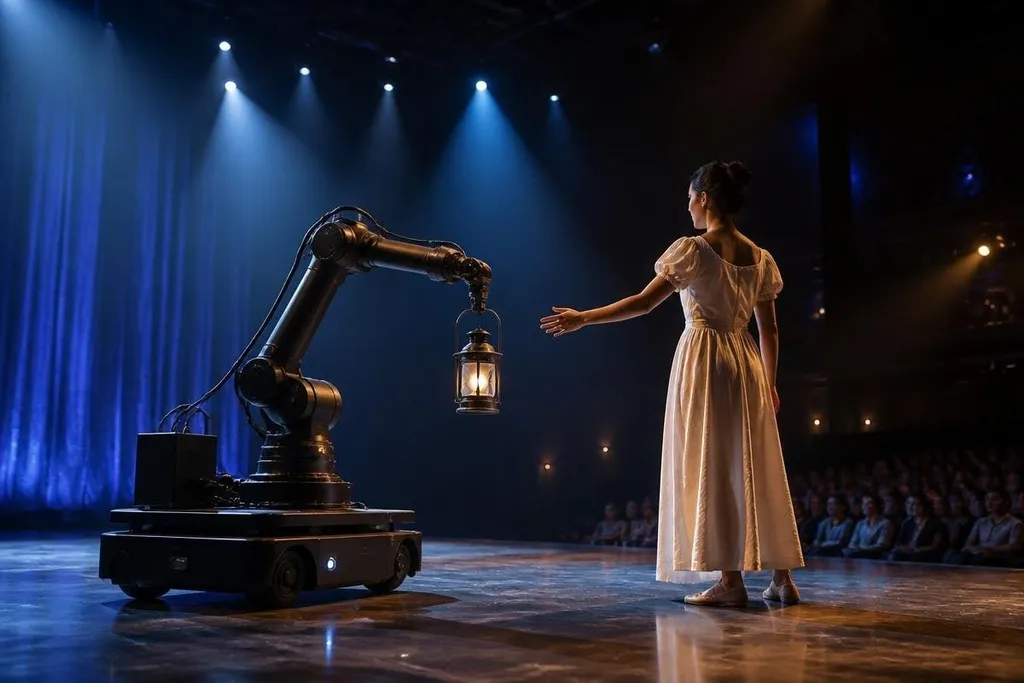
A robot on stage can move, speak, carry props, or react to a performer. Without a verified source pack for a named system, the useful question is not which robot will lead a show; it is where automation can work safely and repeatably.
- Robots can repeat timed movements without tiring.
- Operators still need control when people and machines share a stage.
- The hard limits are noise, safety, repair time, and cost.
What robots can add to a show
Entertainment robots could give directors movements that are difficult for a person to repeat many times. An arm can follow the same path for each performance, while a mobile robot can carry a prop between marked points on the floor.
That repeatability matters during lighting cues, camera moves, and live music. If the robot reaches its mark at the same point in every run, the crew can build other stage actions around it. The result comes from control and timing, not from the robot looking human.
The system can also act as a moving stage object. It might carry a screen, move scenery, or change position during a performance. Each task needs a clear limit: where the robot may travel, what it can carry, and what happens when a sensor or motor fails.
The audience sees the motion, not the control system
A live show hides much of the work that makes a robot safe. Operators may need to watch camera feeds, check the robot’s position, and stop its motion when a person enters its path. That work continues during rehearsal and the public performance.
The robot’s speed must fit the room. A fast movement can shorten a scene, but it also leaves less time for a person to react.
A slow arm may look less dramatic while giving the crew more time to stop it. Directors will have to judge the movement beside the people who work near it, not only from the seats.
Noise creates another limit. Motors, fans, wheels, and cooling systems can affect dialogue and music. A robot that works well in a workshop may need different settings for a quiet theater. The production team also needs access to charging points, spare parts, and a clear route for moving the system off stage.
That makes repeatable performance the next check: can the robot reset between takes and reach its charging point without a crew member stepping in? Robot24.com robotics reporting can help producers compare dated trials, runtime, and operator support before planning a full show.
Where the idea can fail
The first weak point is recovery. A person can pick up a dropped prop or change a movement after a cue. A robot needs a programmed response, an operator, or both. If the recovery plan takes longer than the scene, the robot becomes a delay in the production.
The second is setup. A stage changes between acts, and floors may have ramps, cables, painted marks, or uneven surfaces. A mobile robot needs a known route and a way to stop without blocking performers or crew.
Cost also reaches beyond the robot itself. A producer may need software, an operator, safety checks, transport cases, rehearsal time, and repair support. No source pack is supplied here for a product price, so a budget figure would be guesswork.
I’d put repeatable motion and safe recovery ahead of a human-like appearance. A machine that moves scenery at the same point every night has a clear job; a machine added only because it looks unusual has a harder case to make.
A practical production check
Before adding an entertainment robot to a show, the team should check:
- Define the task: write down the robot’s exact action, route, speed, and load.
- Mark the space: keep people, cables, scenery, and the robot’s travel area on one stage plan.
- Test the stop: check how operators stop motion and how long the robot takes to come to rest.
- Plan a failure: decide who removes the robot, resets the scene, or continues without it.
- Count the support work: include setup, charging, transport, software, training, and repairs.
That list changes the design discussion. It moves the robot from a visual idea to a stage system with a job, limits, and a recovery plan.
The next useful proof will be a full performance run with no hidden cuts, repeated cues, people nearby, and a recorded failure response. Until producers can see those details, entertainment robots belong in controlled stage tasks rather than as untested replacements for performers.